
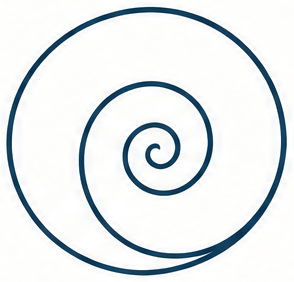
Summary of the law
The law of fractals states that
the way you do one thing is the way you do everything.2
It suggests that seemingly random structures contain a hidden order. Chaos often appears disorganized, yet within it, certain repetitive sequences form patterns. These recurring sequences create structure within the chaos.
Think of a fern: each leaf has the shape of the whole frond, and each leaflet has the shape of the leaf. Mathematicians call this self-similarity.
According to this law, each small fractal is a perfect representation of the whole. Whatever sequence you take from someone’s life—whether it’s a moment, a day, a week, a year, or a lifetime—that sequence reproduces and reflects the whole.
A fractal is a process, not a single event, and it doesn’t have to have a name. In the end, it’s just a sequence of steps leading to a predictable result. It doesn’t necessarily need an external label.
Patterns rarely occur in isolation: the same pattern shows up in other areas of a person’s life. For example, a business owner had unexplained highs and lows in his company’s revenue. When we looked at other areas of his life, we found the same volatility there too.
Problems happen when…
Problems happen when we try to fix a problem in one area of life without seeing the pattern behind it. When people don’t address these patterns, they usually end up managing symptoms. As a result, the problem resurfaces again and again in the same or a similar form.
Who wrote about this law in the past, in various forms
Three examples of individuals who wrote about the law of fractals in the past, in various forms, are:
Carl Jung (1875–1961): In the 1910s, Jung wrote about archetypes, which are universal, recurring symbols or patterns within the human unconscious. These archetypes, like fractals, reflect an underlying order in the psyche. He described archetypes as part of the collective unconscious, which is a deep layer of the mind shared by all humans, made of inherited patterns.
Joseph Campbell (1904–1987): Campbell expanded on Jung’s work and wrote about archetypes extensively in his book The Hero with a Thousand Faces (1949). He showed that the same pattern, the hero’s journey, repeats in myths across cultures and centuries, like a fractal across human history.
Benoit B. Mandelbrot (1924–2010): He formally introduced the term “fractal” in 1975. His 1982 book, The Fractal Geometry of Nature, demonstrated that irregular structures in nature possess a hidden order.
Personal Story - How Monica Ion applied the Law of Fractals to human behavior
A few years ago, I went out for dinner in London with my teenage daughter, Elena, and her new friend, Katty. We were exchanging casual conversation when Katty shared something peculiar about her eating habits.
“The way I deal with food is simple,” she said. “I eat one type of food for every meal—breakfast, lunch, dinner—until I can’t stand it anymore. Then, when I feel sick and throw up, I stop eating that food altogether and won’t touch it for a long time.”
I found this habit fascinating. It wasn’t just quirky; it was a perfect example of a pattern that could manifest in other areas of life. A fractal, I thought to myself.
Later, when Katty excused herself to the bathroom, I leaned over to Elena. “Can you guess how her friendship with you might end?”
Elena raised an eyebrow. “No,” she said. “But I’m curious to hear what you think.”
“Well,” I began, “I could see the two of you becoming very close, and then one day, the friendship might just end. Suddenly.”
Elena’s eyes widened in disbelief. “That sounds tragic, Mom! I don’t think that’s going to happen.”
Teenagers often believe their parents can’t possibly be right. And honestly, we aren’t always right. But something about Katty’s patterns stood out to me.
When Katty returned, I decided to probe a little further. “Katty,” I asked, “have you ever been really into something and then suddenly stopped?”
“Oh, totally,” she said. “I’m an artist, and once I decided to focus entirely on oil painting. I invested everything into it, painting obsessively, and then one day, I just gave up. Completely.”
She continued, “Then I moved on to pottery. I got really into clay modeling. And, same thing… after a while, I just quit.”
The pattern was clear. I glanced at Elena and made a subtle gesture, as if to say, “See?” But she wasn’t convinced.
A year later, exactly as I had predicted, their friendship abruptly ended. One day, they were inseparable; the next, they weren’t speaking at all. Katty’s tendency to immerse herself fully in something and then abandon it had played out in her friendship with Elena.
But it didn’t stop there. A little while later, Katty’s relationship with her boyfriend followed the same trajectory. They had been incredibly close, and then, suddenly, it was over.
Reflecting on this, you may notice that the specifics—whether it was food, art, friendships, or relationships—didn’t matter. It wasn’t about the content; it was about the process. Katty’s pattern of thinking, feeling, and behaving created the same outcomes across different areas of her life. The structure was consistent, regardless of the context.
This story serves as a reminder that understanding someone’s patterns can offer profound insights into how they navigate the world. It’s a fractal—a small, repeating pattern that mirrors itself on a larger scale. And once you see it, you can’t unsee it.
Note: The client stories in this summary describe individual experiences and are shared to illustrate how the laws work in practice. Results vary from person to person and are not guaranteed. This summary is for educational purposes and does not replace medical, psychological, legal or financial advice.