Limited seats available. First session: January 27th
You’ve seen vision boards everywhere from influencers and celebrities to neuroscientists.
Usually they sit right next to manifestation, EFT tapping, breathwork, and morning routines.
Everyone seems to have a version of it. Everyone has a tip.
Everyone has a story about how it “worked for them.”
So you build one.
You pick the pictures. You put the words on it. You make it look right.
And for a day or two… it actually feels good. Like you finally did something for you.
Then life comes back…
A message you need to answer. Something your kid needs. A deadline. A client. A bill.
And it’s not that you decide to abandon the vision board…
It’s just that your attention goes back to where it always goes.
A week passes. Then a month.
The board is still there… but you’re not using it. Not as a filter. Not as a compass. Not as something you live by.
And that’s when the doubt hits.
And if you’ve ever asked yourself that… you’re not crazy.
The uncomfortable truth is: most vision boards don’t work.
Not because manifestation is fake. Not because you did it “wrong” necessarily.
But because nobody taught you the part that matters most:
how to build a board you can actually live by… when life is noisy.
I learned that the hard way…
In 2019, I moved to London with my wife and her daughter. We found this beautiful house… quiet street, great neighborhood—honestly, perfect.
But behind our house was a block of social housing.
And every day, from my office window, I watched the same scene play out: yelling, arguing, people drinking, sometimes half-dressed, sunflower seed shells thrown everywhere.
It wasn’t a one-off. It was the background noise of the place.
And you probably know what that does to you after a while—how it chips away at your ability to think clearly, to make good decisions, to build anything that requires calm.
So I did what most people do.
I closed the curtains.
Then one night it hit me: if life doesn’t give you something inspiring to look at, you have to create it on purpose.
That’s when I made my fourth vision board.
Not the superficial kind with beach photos, Ferraris and other borrowed ambitions.
This one was structured. Intentional. Built around seven principles I’d already tested through years of decisions, failures, and building businesses in different countries – principles that connected what I focused on with what I actually do day to day.
And, once again, more than 80 percent of it happened.
Not because of magic, but because the process was right.
That’s the part most people never see.
Most vision boards fail for the same reason most personal development fails: it’s absorbed as content.
It gives you a hit of motivation, maybe a beautiful board on the wall… and then life gets loud again, and nothing in your day to day actually changes.
Because let’s be honest: most “learning” now is passive.
A YouTube video in the background. A podcast while driving.
Something you half-watch, half-scroll… and then move on.
But your future doesn’t change from half-watching.
You define the vision and build the foundation
You finish the board and ensure it survive real life
By the end of these two sessions, you don’t leave with “inspiration.”
You leave with a finished vision board.
One you understand. One you trust. One that actually works.
Application required to secure your spot
This is live. It’s hands-on. And it’s built so you don’t end up “meaning to do it” and never doing it.
🇪🇺 Paris (CET) – Tuesday, Jan 27, 8 am – 12 pm
🇺🇸 New York (EST) – Tuesday, Jan 27, 6 pm – 10 pm
🇺🇸 Los Angeles (PST) – Tuesday, Jan 27, 3 pm – 7 pm
🇦🇺 Sydney (NSW) – Wednesday, Jan 28, 10 am – 2 pm
🇪🇺 Paris (CET) – Thursday, Jan 29, 8 am – 12 pm
🇺🇸 New York (EST) – Thursday, Jan 29, 6 pm – 10 pm
🇺🇸 Los Angeles (PST) – Thursday, Jan 29, 3 pm – 7 pm
🇦🇺 Sydney (NSW) – Friday, Jan 30, 10 am – 2 pm
Over the last 20 years, I’ve built five vision boards. And what surprised me wasn’t that one of them “worked,” it was that the same pattern kept showing up again and again.
The first one I made as a broke student who couldn’t afford a bus ticket. I remember cutting out pictures that felt ridiculous back then – numbers and dreams that had no business being on my wall… except they were. So I taped them up anyway.
And then life did what life does: it tested whether I was serious.
Roughly 80% of what I put on that first board became real, and the same happened with every board I made after that.
Not always in the exact form I imagined… but consistently enough that I started paying attention.
That’s when I began reverse-engineering what was actually happening.
It came down to seven rules. Not “tips.” Rules.
Because they decide whether your board stays inspiration… or becomes something you can live by.
Here are the first two:
One year is usually too short to change skills, identity, and environment. Ten years is so far away it never touches your Tuesday.
But 4-5 years is close enough to guide daily choices… and long enough for effort to compound.
I once put a Ferrari on a board because people around me were into them. Truth? I didn’t care.
And when you don’t care, you don’t move. The board can’t save you from that.
You can dream big. Wild. Unreasonable.
But the visions that come true are the ones you’ll reorganize your life around when motivation disappears.
The remaining five rules are where most vision boards either start working… or fall apart. We’ll build them together in the workshop.
Application required to secure your spot
Stefan is the one who built the method you’ll be using in this workshop.
He’s been doing vision boards for over twenty years as a way to stay oriented while making big decisions: starting businesses, changing countries, taking financial risks, and navigating periods where clarity mattered more than motivation.
His background in education trained him to explain complex things simply. His work in theology gave him a long-range perspective on meaning and intention. His ongoing neuroscience studies keep the method grounded in how attention, priorities, and decision-making actually work under pressure.
Stefan has built more than fifteen businesses in different markets. Some failed. Some reached top national and international rankings. And all exposed a simple truth: if a vision can’t guide decisions when things are uncertain, busy, or uncomfortable, it doesn’t guide anything at all.
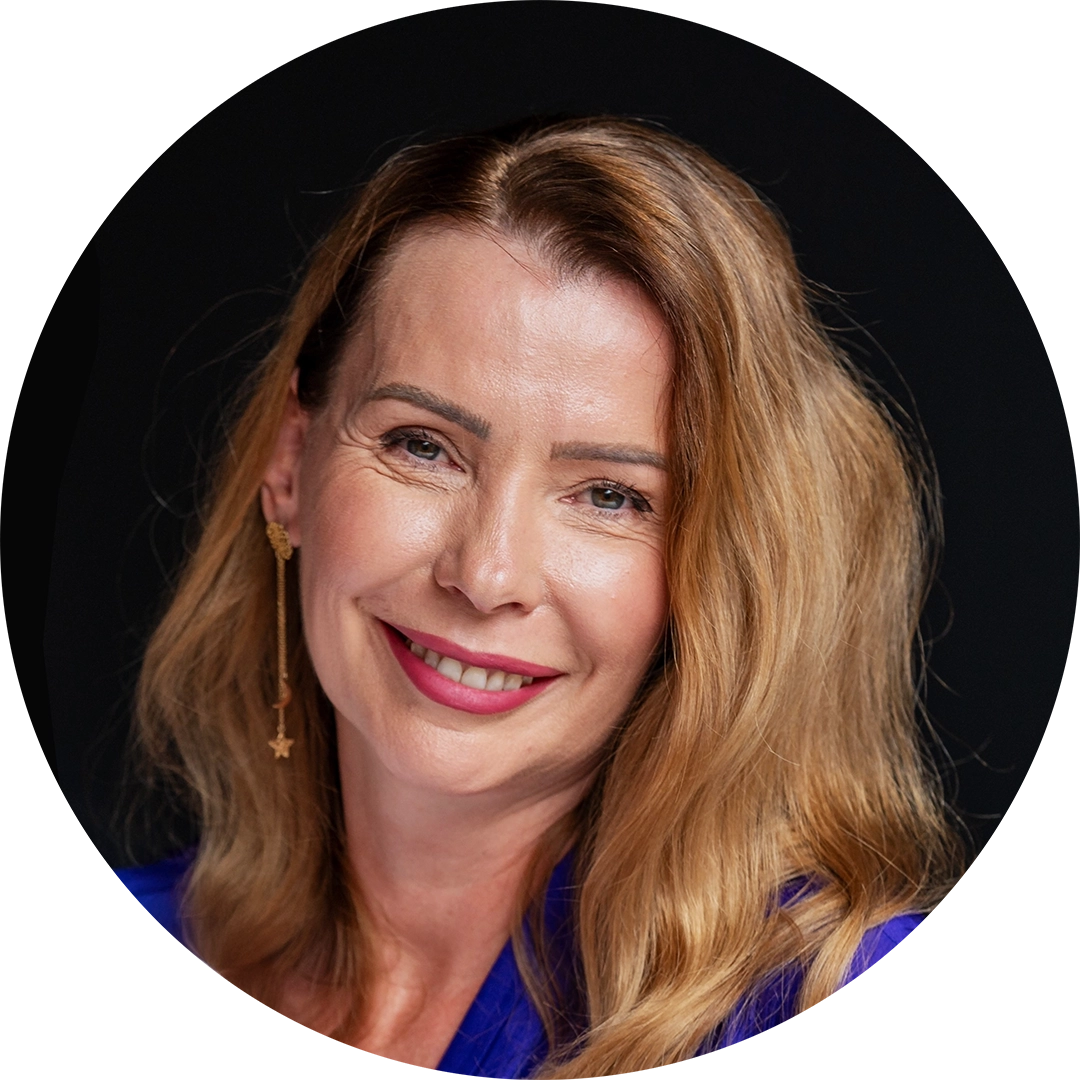
Monica is a psychologist and coach who has spent years watching a very specific problem unfold: people set a direction with a clear head, and when life happens they slowly slip back into the same choices.
Between 2017 and 2023 she did over 15,000 hours of 1:1 work and built the School of Universal Laws and her FTP methodology out of that experience.
In this workshop, Monica helps you narrow your vision down to what you’ll actually act on, not in ideal conditions, but on ordinary days when energy is low and attention is split.
This isn’t a creative exercise. There’s no judging, no comparing, and no pressure to make something “beautiful.”
What you’re building here is functional. Clear. Legible to you. If you can make decisions in your life, you can build this board.
That’s actually one of the most common starting points.
Clarity isn’t something you need before the workshop, it’s something that emerges during it. The structure is designed to help you narrow down direction without forcing answers or pretending certainty you don’t have.
Both, and it ends in action.
We work with intention, meaning, and inner alignment, but everything is translated into something concrete you can use: how you choose, where you focus, and what you stop chasing.
No. Some people arrive with nothing. Others arrive with too much. Both are fine.
You can build your board in the format that fits your life.
What matters isn’t the medium, it’s that you’ll know how to use it afterward.
Yes. This is a live, hands-on workshop, not something you watch in the background.
Having your camera on helps keep the space focused and allows us to guide you properly as you build. You don’t need to perform or speak the whole time, you just need to be present.
That presence is part of why people actually finish the board instead of drifting away.
This workshop is designed to be done live. The structure, pacing, and guidance all depend on you being present and building alongside us.
If you know you won’t be able to attend live, this probably isn’t the right moment to join. The value here isn’t in watching, it’s in doing, in real time, with support.
Most people don’t need more ambition.
They need something that holds them steady when everything feels urgent.
Because the real cost isn’t “not having a vision board.”
The cost is another year of doing a lot… without feeling like it’s building toward anything.
So if you’re ready to stop drifting and actually set direction in a way you can return to, join us live.
Copyright © 2026 Inspired Life Circle. Privacy Policy
Meta does not endorse, recommend, or guarantee this product or service, nor is it involved in its content or delivery. This program is an educational tool based on Monica Ion’s experience and does not constitute a medical diagnosis or replace professional psychological counseling.
Limited seats available. First session: January 27th